Artisanal Perfumes
If you go more than skin-deep in the world of fragrances, it is impossible to ignore those artisanal perfumers — creatives who run a single-person operation, or have a very small team of people supporting them, while they are still doing all the critical aspects of what goes into making a fragrance. They source it, they distill it, they blend it, bottle it, package it and so on. Many of these perfumers rely on highest quality rare ingredients like oud, deer musk, ambergris, and sandalwood; focus on natural realism over synthetic projection; use low-tech and traditional methods of maceration, tincturing, and distil in small batches; and finally, are rooted in heritage perfumery, the art of storytelling and maximalist approach to fragrances. Many — but not all — of them entirely avoid the headache of getting their perfumes IFRA-certified, therefore rely heavily on word-of-mouth and direct-to-consumer selling. Examples of artisanal perfumers include Sultan Pasha, Dmitry Bortnikoff, Russian Adam, Ensar Taifi, JK DeLapp, Prin Lomros and the many others I dont know about.
Artisanals are anti-thetical to literally every aspect of a perfume you find at a department store or at an airport duty-free shop. A department store, for instance, focuses on perfumes they can make consistently for several years, if not decades. An artisanal perfumer will buy any quantity of the highest quality ingredients and make a batch of perfumes that can fit into that. When the batch is sold out, the perfume is gone — often, forever. A department store focuses on notes that are likely to please most people during their buying experience which doesn’t last more than a few minutes. In fact, I would argue that most people make their buying decision within few seconds of smelling something. This means most department store fragrances are over-indexed on making the top-notes most appealing. The perfumers of these perfumes spend disproportionate amount of time, energy, creativity, and money making sure they get the top-notes right. On the contrary, artisanal (and even niche) perfumery focuses heavily on base notes, which speak to the perfume experience hours after it has been spritzed. Third, department store perfumes will use and over-use familiar notes to death, especially the ones that contributed to the success of a past perfume. Jasmine, Lavender, Leather, Citruses (Lemon, Bergamot, Grapefruit, Orange, Mandarin, Bitter Orange, Neroli), Rose, Vanilla and the like. I remember once going to an artisanal perfume boutique and telling them what my tastes are. The shop owner asked the sales guy what to show me and he said “….you can skip the Bergamot fragrances..”. Niche and artisanal perfumes display two levels of liberation from the mainstream. First off, niche perfumes are somewhat independent and creative in their thinking — they bring to life whatever vision they have, and use whatever ingredients they have to, to achieve that. However, they still respect IFRA norms and anti-cruelty norms. IFRA norms will dictate the maximum % of a note they can use in an undiluted oil — this is to protect people from allergy-causing molecules, and skin-reactions of certain molecules (Rose, Patchouli, Labdanum come to mind). Anti-cruelty norms ensure they don’t kill animals (deer for musk) or torture them (civet cats, as an example). Note that there are animal by-products that are entirely cruelty free (such as ambergris). Niche perfumers literally don’t care about IFRA or anti-cruelty, and marginally care about skin-reactions. So they will get basic allergy panels done, but wont stop at anything to achieve the effect they want.
Because of all of these reasons (quality of ingredients, scanty distribution network, (lack of) economies of scale and so on), artisanal perfumes tend to cost a lot more. If you can buy a designer fragrance for less than $2/ml, niche perfumes will cost you between $2 and $6/ml. Artisanal perfumes, especially the undiluted oils and attars, can be much more expensive. A 3ml Chypre Narcisse attar at Sultan Pasha Attars, of this this writing, costs $340 (or $113/ml). A 50ml Tabac Dore extrait at Bortnikoff Parfums costs $350 (or $7/ml). A 100ml Santal Royale pure parfum at Ensar Oud will set you back by $3,150 (or $31/ml). Prin’s “0125” costs $520 for a 30ml (or $17/ml). So the emphasis is increasingly on the quality of ingredients, quality of distillation, quality of blending, originality and the daringness of the ideas etc.
As I got into the world of perfumes, it was inevitable to my curiosity that I got myself into learning about these perfumers and these perfumes. I currently own three of these perfumers — Bortnikoff, Areej le Dore, and another perfume I will talk about in a separate post.
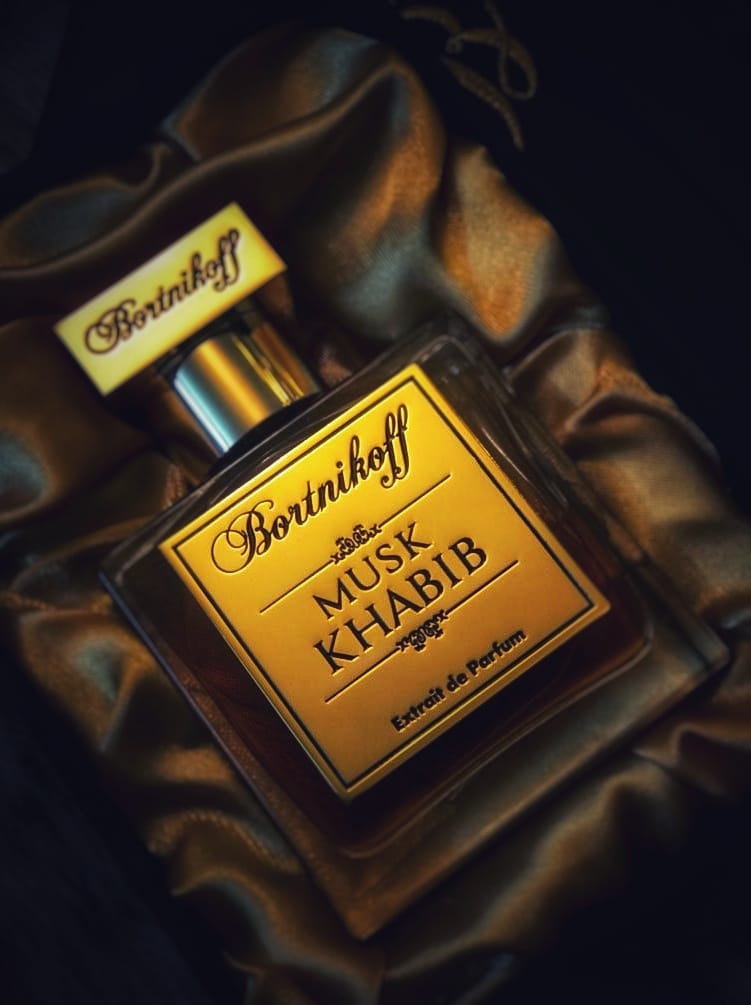
Image Source: facebook.com
Bortnikoff — Dmitry Bortnikoff runs Bortnikoff Parfums out of his distillery in Thailand. I had first ordered the sample set of his, so I can decide for myself what I wanted. Another thing about artisanals is that they are too hard to find in Brick/ Mortar stores, and even if you do, you are unlikely to find testers. So you kind of have to play to your instincts. When I got the sample set, the clear winner to me was Musk Khabib (“MK” here on), a perfume that highlights a beautiful note of natural musk. What is Musk? Musk is an ingredient that comes from a musk pod (a gland) found in a specific type of deer found in parts of Asia and Russia. In order to secure the gland, the animal has to be killed (it is not clear to me if it can be secured from an already-dead animal). Most countries have banned this practice, and only ways perfumers still secure natural musk is (a) through kill tags issued by the government to control over-population/ nuisance/ diseases etc (b) illegally (less common). Perfume industry has an interesting relationship with this ingredient. You might think synthetics dominate the perfume world and it is a recent phenomenon, but with musk, synthetics have been used for more than 100 years now. There are fantastic perfumes that utilize synthetic musk, some of which I will discuss in another post, but MK baffled me in a good way. You would think natural musk is more off-putting/ disturbing/ repulsive than synthetic — this couldn’t be further from truth.
As I wore MK, I imagined myself to be standing in the middle of wilderness, no structures several miles in any direction, like in African savanna. I am standing right next to a deer, with my nose rubbing his body, smelling all of his wilderness — his habitat, his fellow deers, his excrements, his sweat and so on.
Not only is the natural counterpart softer and smoother than the synthetic, it actually smells good. Of course, MK has other notes like Cardamom, Oakmoss (natural, I am assuming), Vanilla which help round out the overall effect. Some of the hardcore fragheads I follow consider MK an entry-level animalic, but for me, this is plenty animalic and plenty smooth all at the same time. One of the best real Musk perfumes in my library!
Areej le Dore (AlD) — Russian Adam runs AlD out of his distillery in Indonesia. Adam is a bit of a cult figure with the fragheads. In addition to everything I said characteristic of artisanal perfumers, Adam is also someone that speaks and celebrates India, India’s contributions to the world (which I have written about, in a Nissaba post), and in particular, India’s traditional distillation methods, especially for Attars. Attars have two connotations. Any undiluted perfume oil is considered Attar by many most people. You can have 4 or 40 ingredients in a perfume — but after the extraction, distillation, blending, maceration processes are over, it is ready for dilution with perfumer’s alcohol. If a EDT is 4% oil, an EDP 20% oil, and a Parfum 40% oil, an Attar is 100% oil. This is the simple definition. An attar in an Indian context has another meaning. In the French world of perfumery, scent molecules are extracted from each individual ingredient — whether a botanical or an animal product — and then blended through the masterful process of perfume making. With Indian Attars, the distillation process combines the ingredients in-process, so that outcome is greater than the sum of parts. This is practiced in many places, but particularly in the Kannauj region, which is the perfume capital of India. Adam also talks extensively about uniquely Indian ingredients like Jasmine, Saffron, Vetiver, Tuberose and so on. I bought five perfumes of Areej le Dore at once (will explain why later). Since Adam makes very small batches, when he creates new perfumes that are inspired by old perfumes, he gives them version numbers. He confesses that between the versions, the ingredients are not the same, the exact effect is not the same — but close enough to be given that name. I will write about the different perfumes I bought in future blog posts. For what its worth, the perfumes I got were — Le Mitti, Inverno Russo, War and Peace, Antiquity and Oud Luwak.
A note on buying from artisanal perfumers — artisanal perfumers dont make large batches, dont make millions in profits, dont have a n-tier distribution network. What they also don’t have a decent shopping experience. Their websites are sucky (reminding me of trying to buy something online in 2001), customer service a hit or a miss, and shipping times are obscenely long. Also, perfume like AlD are in high-demand, but only made in small batches. My most recent experience with AlD suggests that I should either become an insanely patient person, or just give up on buying from these sites. I am so glad I got multiple perfumes during this purchase.
A note on other perfumers in this league — there are several more perfumers who are not artisanal per se, but pay lot of attention to ingredient quality, sourcing ethics, community impact and so on. I could not write about everyone, but the list includes Remi Pulverail, Hiram Green, Andy Tauer, Sebastian Tissot and many more.