Deconstructing the crisis
Why this recession is multi-factorial, and how to make sense of it
Science by definition is deterministic. Sometimes the odds can be poor, but odds too are deterministic. There have been attempts to pass off macroeconomics as science, but macroeconomics involves people and their behaviors, their response to the various devices of macroeconomics. Insofar as employment continues to be part of the central bank mandate, the degree of variability is widened, and the ability to be deterministic is further diminished.
What is going on with the world today? I am going to try to do my best to articulate how I internalize it. This is not the answer, and may even be faulty. If you learn even a small thing from this, I will have done my job. But if you are a trained economist, please do yourself (and me) service — don’t read this.
Lots of phenomenona at work — but two of them deserve a mention.
First — The war between Russia and Ukraine has fueled an energy crisis. Countries have responded by slowing or stopping buying, or not changing at all. This has caused significant instability in the global supply of oil. In addition to this (or as a result of this, I am not sure), Aramco announced that the reserves are depleting, and the world will soon have less oil than needed, on a daily basis.
Second — China continues to have one of the most restrictive policies for containing Covid outbreaks. Specifically, it is (likely) the only country in the world that has a zero-covidpolicy. This has significant impact on their manufacturing and supply-chain sectors.
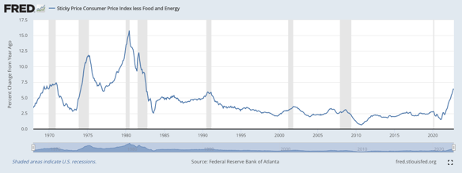
Combine these two factors — you get what is called cost-push inflation. What this means is you got the same amount of money chasing fewer goods, pushing the cost of these goods up. In simple terms, this means you wait longer or you pay higher to get everyday goods like electronics (itself affected by a semiconductor crisis), furniture, and pretty much any item that requires finished or raw materials from China, or fuel to transport them between two places. We also have issues like labor shortage in critical industries like shipping and trucking, exacerbating this crisis.
Source: https://fred.stlouisfed.org/series/CORESTICKM159SFRBATL
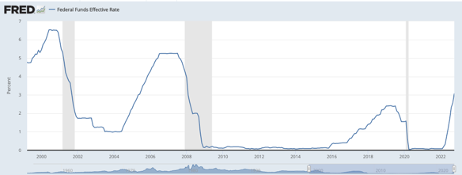
Meanwhile, several countries including, most importantly, the United States, have maintained zero or near-zero bank rates for a very long time. The federal fund rates have been held at ~0% for many years now — started at 0.18% shortly after the 2008 GFC through 2015, slowly reached 2.42% by July of 2019 — this is when things started to look better, and the Fed wanted to get ahead of inflation. Covid started affecting us around Jan 2020, which caused the Fed to once again reduce interest rates to near-zero percent, where it remained until March 2022. Even the 0% rates were not enough to encourage spending. Monetary tools like bank rates and Quantitative Easing were all done in an effort to ventilate an economy which, it seemed, was on life-support.
Source: https://fred.stlouisfed.org/series/FEDFUNDS
Because of the over-supply of money, individuals and businesses found it easier to borrow money — some used it to buy video games and Crypto accounts, but some others founded startups, while businesses increased their investments in the hiring of outsized workforces — and paid them a lot. Earlier, I was talking about a cost-push inflation, but too much money in the hands of too many people caused a demand-pull inflation. Perhaps the greatest impact of this could be seen in the real estate market between 2021 and H1 of 2022 — people were buying properties well above the listed price, foregoing contractual protections, and one-upping competing buyers.
The primary job of the central bank (of most countries) is to manage inflation and use monetary policies as lever to keep inflation in check. In the US, the Fed has a dual-mandate — of achieving full-employment in addition to controlling inflation. Since the GFC in 2008, with the exception of a small period in 2019, the US has been riding the wave of cheap money. If not for Covid, I suspect we would have departed from the zero-percent days starting in late 2019; but alas. But in Q1 2022, the Fed learnt that inflation was getting out of control (because of both cost-push and demand-pull), while at the same time a weird phenomenon started happening with employment. I will go to the employment angle later — but essentially our inflation numbers were going up like crazy, while at the same time the overall output of the country was not going up.
When the US de-grows 2 quarters in a row, it meets the book definition of a recession. Inflation going up at the same time the economy was stagnating (sometimes called stagflation) could not be explained by anything other than energy crisis, the supply chain crisis and the idea of cheap money in US.
Essentially, we aren’t producing more, we aren’t becoming more productive, in fact we are not even consuming more — we are just paying more money (available cheaply to us), to buy fewer goods (made more expensive by the two crises).
Source: https://fred.stlouisfed.org/series/CORESTICKM159SFRBATL
The Fed doesn’t (and cannot) control the cost-push inflation. The only thing it can do is reduce demand (the technical-ish term for this in demand destruction) by increasing the cost of money. The Fed, since Q1 2022, has increased the FFR by 300 points — effectively pushing the rates from near-zero to 3%. 3% is what the banks charge each other, but when the money lands in your hands and my hands — it is often much higher. For example, the credit card APRs went up, the mortgage rates went up. So much so that people have (or will have, in a period of time) stopped or reduced consumption significantly.
The Fed’s Chair has said in Oct 2022 that we are not done tightening — FFRs could go as high as 5%, possibly more. This is informed primarily by the inflation indices that are created every month.
So how does this play out from now? Fed increases the rates let’s say 2 or 3 times — let’s say 2 times by 75 basis points each time — bringing the FFR to around 4.5% — which will really put a lot of strain in the economy, because it will make more people jobless, make fuel/ food/ heat expensive — causing a long, dark winter. At the end, if the magic happens, like Powell believes, inflation will get under control. But by that time, the economy would have been crushed into what is a hard recession in traditional terms — while there is reason to believe the recession started as early as Spring 2022, we won’t be done feeling the effects of it, at least until Q2/Q3 of 2023. This long a period of continued tightening could reach the levels where it can create social unrest.
Say, we prevail. And prevail, we will. Unfortunately, few issues will still remain, well after the end of this inflation crisis.
1. Energy crisis — So long as Russia is in war with Ukraine, and OPEC’s oil reserves continue to deplete, the energy prices will continue to surge. On a sidenote, if you are thinking EVs will help offset this supply crisis, don’t even bother — EVs have not so much as scratched the surface of the supply-demand equation of fossil fuel.
2. Supply Chain crisis — While demand destruction will help in the short-term, a longer-term solution is needed. This is beyond my ability to understand and write.
3. Debt crisis — US now has $31.25T in debts, which represents between 124% and 131% of GDP. This is untenable, and will soon put US in the same position as it was in 1971, before Bretton Wood was scrapped, or when India almost went bankrupt in 1991. Fiscal conservatism and responsible money have been a foregone conclusion for politicians on either side of the economic spectrum. Interestingly, there is no data to suggest more debt creates/ fosters or supports an environment of growth. Put simply — the US is just plainly becoming reckless.
4. Currency crisis — The US Dollar is the primary currency of US and the Fed has every right to defend it based primarily, if not exclusively, on US’s economic interests. The US Dollar is also the world’s reserve and trade currency. This creates tensions — when the US economy contracts, the rest of the world also goes into a recession-esque climate. Politicians on either side of the spectrum have turned populist — and Covid-like handouts (which caused inflation both monetarily and fiscally) have been mainstay. This is likely have disastrous consequences.
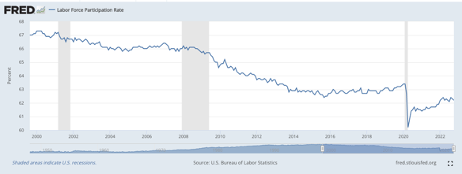
5. Unemployment — Unemployment stats are funky. At least in the US. The way they are calculated, does not pay attention to the labor participation rate, which has been on the decline. I suspect at least one of the reasons for this is the changing landscape of jobs and skillsets. If more people have to participate in the labor force, more people have to have the skills that the market needs. This is an area we can impact as a society.
Source: https://fred.stlouisfed.org/series/CIVPART
At the end, inflation is like the fever — it is a symptom, not the problem. And since 1971, the US (and the world in fact) has fallen into a pattern of fixing the symptoms, and tucking away the problems, which is what the world needs to be working on.