Malli Nadu by Nissaba
When you spritz a luxurious French perfume or an acclaimed American fragrance, chances are — without even knowing it — you’re wearing India.
From the fragrant fields of Kerala to the lush valleys of Kashmir, India quietly produces some of the most prized natural ingredients in the world. Perfume houses across Paris, New York, Tokyo, and Dubai rely on these treasures to craft scents that fetch thousands of dollars a bottle. Yet, India rarely gets the spotlight.
Consider this:
- The world’s finest jasmine? Picked in Tamil Nadu’s early dawn hours.
- The most aromatic cardamom? Grown in Kerala’s misty hills.
- Regal saffron? Hand-harvested in Kashmir’s short, golden season.
- Legendary Mysore sandalwood? So rare, it’s now a protected resource.
- Exquisite tuberose from Coimbatore, and oud from Assam’s dense forests.
These ingredients journey halfway across the globe — sometimes as raw botanicals, sometimes as precious extracts — before being transformed into luxury fragrances. But here’s the twist: while India excels in cultivation and extraction, the art of blending and marketing has mostly been monopolized elsewhere.
That’s why names like “Bulgarian Rose” or “Cambodian Oud” are celebrated on perfume bottles, while Indian origins remain invisible. Only insiders — those sourcing teams at giants like Givaudan and IFF and Firmenich — truly understand just how deep India’s contribution runs.
Still, a few visionary perfumers are changing the narrative:
- Shalini Kumar of Shalini Parfum, merging Indian inspiration with French refinement.
- Purvi Joshi of Peosym, infusing modern perfumery with Indian botanicals.
- Neela Vermiere of Neela Vermiere Creations, crafting olfactory stories rooted in Indian culture.
And then there are homegrown brands — Bombay Perfumery, NASO Profumi, Boond, Olfa, and Isak — carving space for “Made in India” fragrances, though still niche in global awareness.
Interestingly, some independent houses openly celebrate their Indian ingredients:
- Russian Adam (Areej le Dore) — an artisan perfumer famed for high-grade Assam oud.
- Remi Pulverail (Les Indemodables) — championing transparency in sourcing.
- Sebastian Tissot (Nissaba) — putting raw material origins at the heart of the brand.
These perfumers share one belief: the quality of the ingredient is king. And with India’s bounty of flowers, spices, woods, and resins, the kingdom is richer than most consumers ever realize.
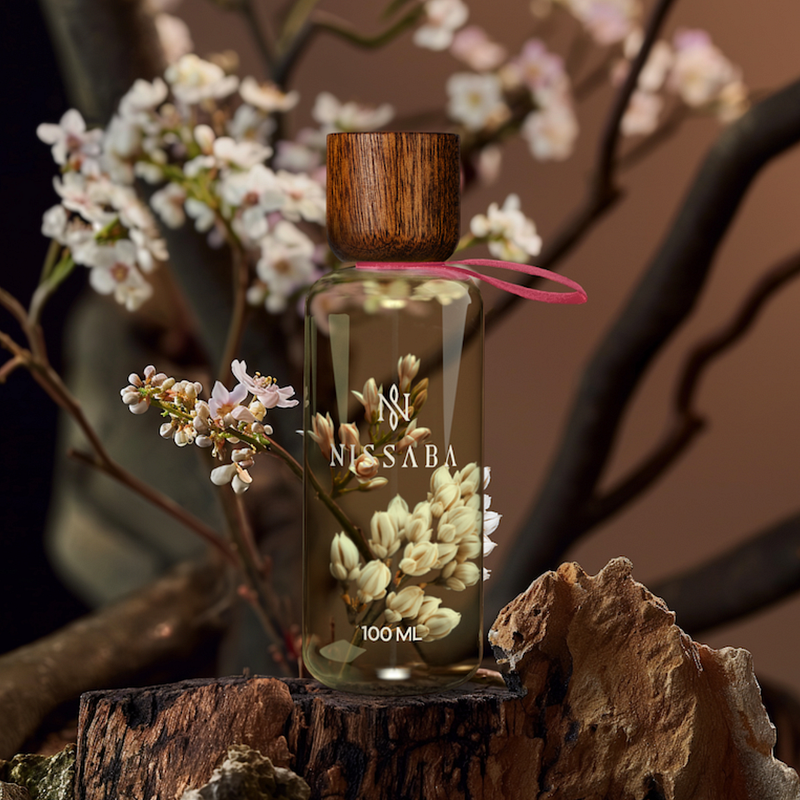
Image Credit: nissaba.com
My most recent discovery is Malli Nadu by Nissaba Fragrances. Sebastian Tissot who owns the brand calls this perfume “India in a bottle”. The nose behind the bottle is Illias Ermenidis, who works for Firmenich. Fragrantica credits Ermenidis with 100+ creations, however this is my first.
What drew me to Nissaba was an interview I watched where the legendary Darius interviewed Tissot. Through that interview, I learned that Tissot was invested in India in a way that truly astounded me. Specifically, Tissot works with a small community in a village near Madurai, trains a small group of underprivileged kids in the trade of cultivation, farming, harvesting, and extraction of Jasmine. The name Malli Nadu (“land of Jasmine”) is a play on the Indian state (Tamil Nadu) and Malli, which is Tamil for Jasmine.
So why is this perfume “India in a bottle”?
- The top notes include Davana (which is better known as Marikozhundhu in Tamil). Other top notes include Orange and Mandarin Orange.
- Heart notes include Jasmine (of course, from Madurai), Tuberose (India), and Paradisone (Firmenich exclusive)
- Base notes include Cedarwood (origin unknown), Vetiver (India), Sandalwood (India)
Of course, our thoughts on perfumes constantly evolve and change over time. But based on the early impression, it is a mild-mannered, pleasant fragrance constantly oscillating between its tuberose-dominance and jasmine-dominance. Of course, tuberose has the nature of over-powering other heart notes of a fragrance, so I found myself asking “Is this a Jasmine frag or Tuberose frag?” and came up with alternating answers. I could really get the Vetiver in the base notes, but not enough of Sandalwood.
Overall, this is a good concept buy, but if one were singularly focused on getting the best jasmine fragrance there is, I may have other recommendations for them.