Perfume Project 2026: Chasing The Unknowns (Part 4 of 4)
Three more perfumers. A slightly broken promise.
Eleven months ago, I gave myself a fragrant little assignment: find perfumers missing from my collection, explore their most celebrated work, and buy a perfume from each.
Not revisit an old favorite. Not writing about a bottle I already owned. This was about seeking out creators whose work I did not own—and giving them some shelf space.
In the first three parts, that pursuit led me to Antoine Maisondieu, Annick Goutal, Michel Roudnitska, Guy Robert, Michel Almairac, Ralf Schwieger, Pierre Bourdon, Marc-Antoine Corticchiato, and Manuel Cross.
The bottles were the souvenirs. Getting to know the people behind them was the point.
Of course, “getting to know” is doing some heavy lifting here. Some perfumers have such sprawling bodies of work that buying one fragrance feels like reading a paragraph and claiming familiarity with the novelist. Others leave you hunting through a much smaller selection of what you can still buy.
And then there are perfumers like Bertrand Duchaufour and Christopher Sheldrake: the gifts that keep on giving. You could devote several shelves to their creations and still suspect that the most interesting discoveries lie ahead.
For this final installment, three more names join the project. But there is a small problem with my original plan.
The exploration happened. The sampling happened.
The buying? That part requires a little creative accounting.
Olivia Giacobetti: An Introduction, Not an Acquisition
Olivia Giacobetti has been hovering at the edge of my perfume education for a while now.
I have become familiar with the names: Diptyque’s Philosykos. L’Artisan Parfumeur’s Tea for Two. Idole de Lubin. But recognizing the landmarks is not the same as having walked the streets.
That distinction matters in a project like this. It is easy to accumulate names, reputations, and other people’s enthusiasm—and mistake all of it for firsthand knowledge.
My actual introduction is more modest: I now have a sample of Idole.
No sweeping verdict on her style. Just an opportunity to start paying attention with my own nose.
Tea for Two remains on my someday list. Finding a chance to try it is part of the chase.
For now, Giacobetti gets an open door rather than a place on the shelf. An incomplete assignment? Certainly. But I would rather leave the chapter open than buy a bottle just to manufacture an ending.
Julien Rasquinet: Following the Bourdon Trail
Pierre Bourdon has become one of the most compelling and mystical figures in my exploration of perfumery. So the next question almost asks itself: where does the influence go from here?
Who carries something of that sensibility forward—and what do they do with it?
That curiosity brought Julien Rasquinet into focus for me.
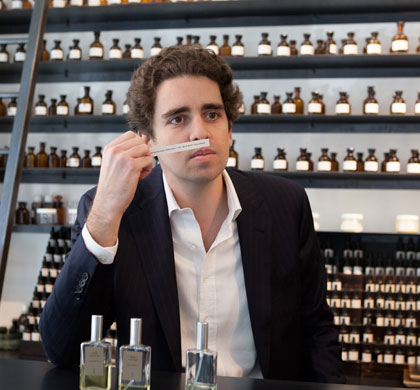
Image Credit: noseparis.com
There is a tempting rabbit hole here involving Creed, perfume authorship, and scandalous behavior of the recently deceased Olivier Creed. But sorting through disputed or unofficial credits could become a series of its own. I would rather start with what I can actually smell. For the record, I told myself I will never buy a Creed, I blame their prices and the tell-all written by Gabe Oppenheim for that.
Which brings me to Frédéric Malle’s The Moon.
A friend in the fragrance community shared a sample, giving me a chance to meet a perfume whose reputation had arrived well before the liquid.
My first response was not quite the revelation I might have expected. Instead, I found myself asking: how do I separate this from Promise (another marvel by Dominique Ropion)?
That is a report from my nose, not a verdict on either perfume. A couple of sniffs are barely a handshake. They are certainly not enough to decide what makes The Moon distinctive—or whether I want to live with it.
It has plenty of time to make its case, and so does Julien.
I realized later that I already had Naomi Goodsir’s Cuir Velours, another Rasquinet creation.
Between those two samples, I have enough to begin exploring properly. What I do not have is a reason to rush.
So, Julien: no bottle yet. Consider this an extended introduction.
Quentin Bisch: Everyone Seems to Know Him. I Am Still Saying Hello.
With Quentin Bisch, I need to begin with an admission: I know very little.
I see his name come up in the fragcomm. But borrowed enthusiasm is not a personal opinion. My starting point is a sample of Ganymede.
To my nose, it feels rich, almost regal—but also sweeter than I would like. There is an imposing quality to it, something that makes me pay attention, even if I am not yet sure I want more.
Perhaps that changes with another wearing. Perhaps it does not.
Either outcome is more interesting than pretending to admire something because its reputation suggests I should.
What I cannot do, on the strength of one sample and limited experience, is offer a grand theory of Quentin Bisch. I do not yet know which qualities recur across his work, which creations might suit me better, or whether Ganymede will eventually click.
For now, the honest answer is also the simplest: I have started.
The Project Ends. The Curiosity Does Not.
So this is how the series closes: delivered on the 12 new perfumers promise, under-delivered on the promise to buy bottles (which also means I came under budget). I am comfortable with that.
A celebrated name does not guarantee a personal connection. A first sniff does not settle a perfume’s worth. And buying a bottle is not the only evidence that an exploration has been worthwhile.
Sometimes the right ending is a purchase.
Sometimes it is another wearing.
And sometimes it is leaving a sample within reach because you are not finished with it yet.
That concludes this year’s chase. Next year gets a new theme.