Perfume Project 2026: Chasing The Unknowns (Part 3 of 4)
We are now firmly in Part 3 of this experiment — nine perfumes in, nine perfumers explored, and a growing sense that “new to me” is the only constraint that really matters. This leg of the journey is less about discovery for novelty’s sake, and more about confronting contradictions in perfumery: anonymity vs authorship, brightness vs depth, rules vs quiet rebellion.
Let’s get into it.
Pierre Bourdon — The Invisible Giant
Iris Poudre, Frederic Malle
Pierre Bourdon is one of perfumery’s most paradoxical figures: a legend whose name you rarely see where it should be.
A student of Edmond Roudnitska, Bourdon inherited not just technical mastery, but a philosophy of composition. And yet, despite creating some of the most commercially and culturally significant fragrances of the modern era — Davidoff Cool Water, YSL Kouros, and widely believed contributions to multiple Creed icons — he spent much of his career in the shadows.
The backstory is almost uncomfortable in its simplicity: a lifetime of self-doubt, shaped in part by a father who believed nothing outside Dior was worth reverence. Whether that fully explains his willingness to ghost-create for Creed is unclear. What is clear is the outcome — decades of influential work, largely uncredited.
That matters to me.
As a principle, I’ve chosen not to engage with Creed. Not because the perfumes are unworthy — but because authorship matters. Perfumery is art, and artists deserve attribution. (There are bottles in my collection that violate this principle — purchased before I knew better. They will not be backfilled.)
Which is precisely why Frederic Malle feels like the ideological counterweight.
Malle didn’t just credit perfumers — he centered them. Put their names on the bottle. Made authorship visible.
So if you want to experience Pierre Bourdon properly, this is where you go.
Iris Poudre is not an introduction to iris — it’s a declaration. Iris doesn’t sit quietly in compositions; it takes over. Powdery, elegant, slightly aloof — it dictates the tone of the entire structure. Even in small doses, iris dominates. Here, it leads.
And through it, you finally see Bourdon — not as a ghost, but as an author.
Marc-Antoine Corticchiato — Structure and Restraint
Parfum d’Empire (Ambre Russe, Azemour Les Orangers, Cuir Ottoman)
This was the first deliberate “cheat” in the project.
Three fragrances. One decision. No access in-store. And a firm rule against blind buying.
So I sampled all three — and counted it.
Marc-Antoine Corticchiato (Parfum d’Empire) is both founder and sole perfumer of the house, which already tells you something: this is a controlled vision. No diffusion of authorship. No committee-built perfumes. No market studies.
The three that drew me in couldn’t be more different.
Ambre Russe Often mentioned in the same breath — or above — Ambre Sultan. That alone sets expectations at an unreasonable level.
What you get instead is not a replacement, but a reinterpretation: more textured, less clean, slightly more rugged. Where Ambre Sultan feels polished, Ambre Russe feels lived-in.
I like it. I respect it. But with Ambre Sultan already in rotation — and Ambre Précieux (MPG) still on my horizon — this sits in a “maybe later” category.
Azemour Les Orangers Before this, a quick detour on citrus.
Citrus dominates the top notes of perfumery because it sells. It’s immediate, expressive, and disappears quickly — perfect for first impressions. The industry optimizes for that moment.
Serious buyers don’t.
They sample. They wait. They care about the dry-down.
Which raises an interesting question: can citrus escape its role as a fleeting introduction and become the spine of a composition?
Azemour answers that convincingly.
Clementine, mandarin, grapefruit, lemon, neroli, orange blossom — layered in a way that stretches citrus beyond its expected lifespan. It’s not just a top note here; it’s a theme.
It works.
But for me, admiration doesn’t equal ownership. I gravitate toward base-heavy compositions, and this — while excellent — doesn’t align with where I spend most of my time in a fragrance.
Cuir Ottoman This is where everything clicks.
Leather, resins, smoke, density — this is not subtle perfumery. It’s deliberate, textured, and unapologetically heavy. Benzoin, birch, styrax, incense — all the elements that create depth rather than projection.
It sits comfortably alongside things I already value: Cuir Cannage (Dior), Anubis (Papillon), and the still-elusive Cuir Mauresque (Serge Lutens).
If I add one Corticchiato to the collection, this is it.
Manuel Cross — Respecting the Past, Bending the Rules
Chypre Siam, Rogue Perfumery
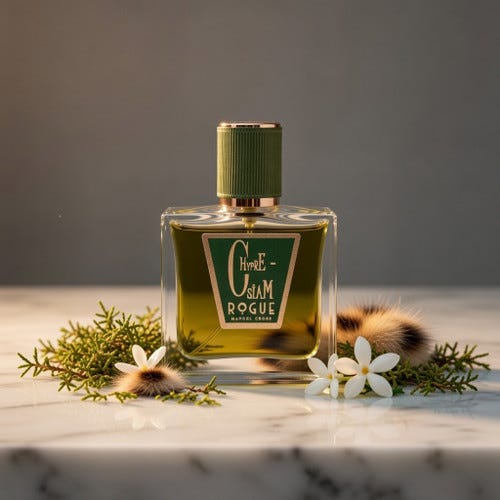
Image Credit: perfuum.com
Chypre is not just a structure — it’s a lineage.
Bright opening, resinous heart, mossy base. A blueprint that traces back to Coty’s Le Chypre (1917), and from there to Mitsouko, Femme, Bandit, Calèche — foundations of modern perfumery.
Manuel Cross took an unusual path into this tradition: from chef to perfumer. But the approach makes sense. Chypre requires balance, proportion, and restraint — more culinary than it first appears.
Chypre Siam is his interpretation. And it arrives in a regulatory era that has aggressively restricted oakmoss — the very backbone of classic chypres.
Which is where things get interesting.
There’s a persistent narrative that Rogue pushed oakmoss levels beyond IFRA limits — a quiet act of defiance. The official stance is compliance. The olfactory reality sits somewhere in between: this smells far closer to a classical chypre than most modern interpretations dare to.
Top Notes: Kaffir lime, basil
Heart Notes: Jasmine, ylang-ylang
Base Notes: Oakmoss, benzoin, civet, leather, spices, sandalwood
The result is dense, slightly dirty, and unmistakably intentional. Not retro for the sake of nostalgia — but rooted in a structure that refuses to be diluted.
Alongside Chypre Palatin and Chypre Mousse, this forms a modern trio that respects the genre without sanitizing it.
Where This Leaves Me
Nine perfumes. Nine perfumers. No repeats.
That constraint is doing exactly what it was supposed to do — forcing exploration while quietly limiting excess. Fewer purchases, more attention. Less accumulation, more understanding.
And it raises the next question: what does 2027 look like?
A few directions are starting to form:
- Go deep on a handful of perfumers
- Explore houses instead of individuals
- Or take on vintage perfumery (high effort, high risk, potentially high reward)
There’s time to decide.
For now, the takeaway is simple: constraints don’t limit the experience — they sharpen it.