Salome by Papillon Perfumery
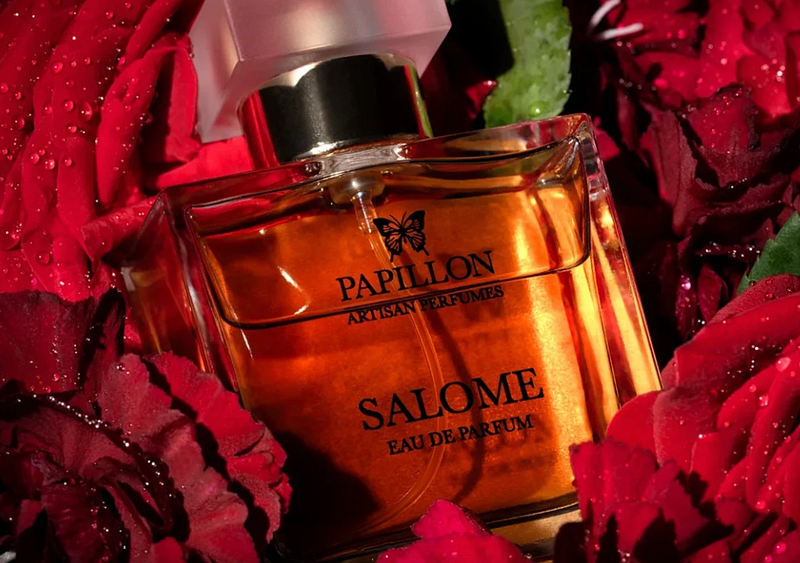
Image Credit: https://papillonperfumery.co.uk/product/salome/
Salome is a special perfume for me. Salome is a chypre, animalic-floral fragrance created by Liz Moores of Papillon Perfumery. Liz made a mid-career transition into perfumery, and must have failed on her many first attempts to create something special. In a moment of despair, she told herself to give ‘one last shot’ at creating something and told everyone everyone around her that she was going to be ‘done’ trying after that. And off the moment of despair came this most beautiful perfume. If I had to get rid of my entire collection, and keep only 10, Salome would be one of them. Papillon doesn’t publish perfumes notes in the traditional tree structure (top-heart-base), so her note listing — without any mention of a tree — includes Jasmine, Turkish Rose, Africa Stone, Carnation, and Musk. A short primer on these notes:
Jasmine, along with Rose, are two of the most-used florals, and can be found on almost every other perfume as part of its heart notes. With more than 100 different varieties, two of them are primarily used in perfumery — Jasminum Sambac and Jasminum Grandiflorum. Sambac (aka Arabian Jasmine) is extensively used in the production of tea and perfumery. It is sweeter, muskier, and more indolic. Indole is a molecule present in Jasmine, which when experienced in large quantities, can be animalic or even fecal. Grandiflorum on the other hand is rich, very floral and slightly green. The best Sambac comes from India and China, while the best Grandiflorum comes from France, India, Egypt, and Morocco. According to Roja Dove, it takes about 1,200 kilograms — or five million flowers — to make one kilogram of the extract (called the absolut). Jasmine can be deployed to invoke the floral characteristics or the indolic characteristics — or both.
Rose may also have several varieties, but three of them are seen commonly in perfumery. Rosa Centifolia (aka Rose de Mai) grows mainly in Grasse France, and has a warm, peppery note. Centifolia literally means 100 petals. Rosa Damascena (aka Damask Rose aka Bulgarian Rose) grows in Bulgaria, Turkey, and Morocco — while the Bulgarian variety really takes the cake. This type of Rose supplies majority of the industry needs by volume. Rose Taif grows in the Taif region of Saudi Arabia, shares characteristics with Bulgarian Rose, but somehow much more special and expensive. Ot tales about 12,000 flowers to make 10 grams of essential oil.
Africa Stone (aka Hyraceum) is the fossilized excrement of an animal species called Rock Hyrax, which has a peculiar habit of urinating and defecating in the same place. The mixture is solidified and fossilized naturally until it is collected. In a world where animal cruelty is greatly frowned upon, Hyrax can be safely used because it has nothing to do with the animal. Hyraceum shares characteristics with other animalic scents such as Musk and Castoreum.
Musk is used as a fixative, but also has its own profile — Musk is a gland inside a certain type of deer (musk deer) — which is a small statured deer found in Russia and India and many other places. Because the extraction of this gland involves the killing of the deer in question, this ingredient has practically been outlawed by the perfume regulatory bodies. However, there are countries in the world that have an overpopulation of musk deers, and provide permits for private hunters to shoot them down and use it. Musk has a very complex olfactive profile — depending on the part of the gland used, it can be powdery, chocolate-y, sweaty, fecal and many more.
Carnation is a flower that displays spicy, warm, powdery, minty characteristics.
Ok. Back to Salome. I don’t experience Salome as having five-notes — it is incredibly complex, and reminds me of many things. For one thing, it reminds me of the inside of a South Indian temple. What we cannot remember through imagery and sounds, we can certainly remember through the olfactive impressions the moment leaves with us. You could have been eating popcorn while watching a movie, and the next time you eat popcorn, you are reminded of that movie. Why? Because your brain has paired that movie with the scent of popcorn. Salome is a perfume I would introduce to anyone who asks me for recommendations. Of course, it is not for everyone — some people may be turned off by the musk and hyraceum — one of the many reasons why mainstream commercial perfumery stays away from these ingredients. I know for the rest of my life I will always have a non-empty bottle of Salome in my collection.