Shakti’s This Moment — A Review
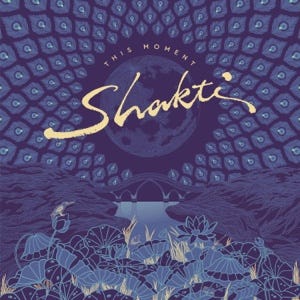
I have been a huge fan of Shakti, have listened to every piece of music of which a recording is available — whether a YouTube session or audio/ DVD release or bootlegged videos. Shakti has influenced my idea of music, appetite for new sounds. Thanks to Shakti — I revere and have followed each of these musicians through their other works both in their respective genres or through collaborative genres. In a way, Shakti opened the doors for me to explore new musicians and to new music. Of course, generations of musicians have taken inspiration from Shakti and their free-spirited music, so my words hardly amount to much.
As a band, Shakti has been in existence for 50 years — yet they have released exactly two studio-recorded albums — Natural Elements and This Moment — with a gap of almost 40 years. This is to say this band is not bound by sales pressures and record companies’ constraints (I imagine this is primarily why they signed with Abstract Logix, though I don’t know for sure).
This moment was released on their 50th anniversary, accompanied by a worldwide tour of concerts. Some of them have just the five core musicians (John, Zakir, Shankar, Selvaganesh and Ganesh), while some others have additional collaborators. Even so, this is the first tour (as far as I know) and first album release after the passing away of any Shakti team member (U Shrinivas, whose music I miss very much).
This Moment has 8 tracks — of which 2.5 songs are flankers. Giriraja Sudha was first released in Saturday Night in Bombay, featuring U Shrinivas on Mandolin and AK Palanivel on Thavil. Sonu Mama was first released in Soukha. I mentioned 2.5 because Karuna was never officially released as a track, hence it is technically not a flanker, but there are many versions of it in YouTube.
First, let me start with my basic premise. Shankar Mahadevan has added immensely to the sound of Shakti and their repertoire. While Shakti was an instrument-only band for the longest time, it is today hard to imagine Shakti without Shankar. Yet I recognize and submit that Shakti had and has a strong identity sans Shankar as well. With that said, 7 out of the 8 pieces had Shankar in it. There’s a tiny part of me wanting to see more of the instrument-only dimension of Shakti.
Secondly, Shakti and their music is defined partly by how percussive it is. And while so many musicians and bands — before and after Shakti — have used Konnakol, this band provided it a permanent seat. John must have fallen in love with it, he utilizes Konnakol even in non-Shakti formats that involve neither Zakir nor Selvaganesh. Inspite of this, I have to say the percussive aspect of the music has become heavy to the point it is taking over the melodic and harmonic aspects of the music. Not only do 5 of the 8 pieces have a Konnakol segment, but the percussive parts of This Moment’s music are somewhat over-powering, in my opinion.
What is Shakti’s musical identity really? I remember seeing John say somewhere that his intention is not to play Indian music. His art was always to introduce western sounds to Shakti. Let me get this straight — some of the pieces are downright traditional Carnatic or Hindustani or semi-classical compositions (Giriraja Sudha, Mukti, Chandrakauns, Shringar, Kriti) — this is to say the pieces are presented in the exact format it would have been presented in a classical Hindustani or Carnatic concert, except with the addition of John’s guitar. Many more songs while not traditional, very much stick to the idea of Carnatic or Hindustani music — which is to say they are more or less consistent with a raga being presented (Maya, Bell’Alla, Joy, What Need I Have For This — to name a few). Yet, the signature of Shakti is not the raga, or the guitar, or the Tabla, or the Indian-ness of the music. To me, it is how they all come together, create the energy that each of these players are capable of independently producing — but do it in a fun and unique kinda way. Natural Elements is a great example of an album that has Indian elements aplenty, yet doesn’t come across like Indian music. Not that there is anything wrong with Indian music — but if I just wanted to listen to a Keeravani or Patdheep or Jog or Vakulabharanam, I’d just pick up my favorite rendition there is of these ragas. In short, Shakti’s unique selling proposition is the space and intimacy between different cultures of music — manifested simultaneously. I humbly submit that this space and intimacy as I call it, has gone off-balance lately, not least due to the fact that there is a language element in the words enunciated by Shankar Mahadevan.
So when I listen to a piece like Changay Naino — I couldn’t help immersing myself in the beautiful Shubapantuvarali rendition from Shankar Mahadevan and Ganesh Rajagopalan. I will probably listen to this 100s of times in the coming months. But why is the percussion so heavy for a song that is almost meditative and contemplative? What is Shakti about this piece? I struggle and I struggle.
Shakti has defied genres, billboards, and record company expectations time and again. Since they don’t seem to be sales-driven, it is unlikely they ever created or will ever create music other than what they enjoy creating. But there is a part of me that almost wishes that Shakti brought in a new sound, a new musical tradition. To put it bluntly, Shakti needs to become a little less Shankar, a little less Indian, and a little more of a new sound.
Shakti will continue to shape my understanding of music to the greatest extent. I will continue to celebrate the band, revere the musicians, attend their concerts, and wear the band t shirts. Zakir Hussain is the greatest drummer whose sound I have had the fortune of hearing.
For now though, This Moment is not my moment.