The Other 1% — Sanjay Chakravorty et al
The saga of Indian success in America is a puzzle wrapped in stereotypes, statistics, and occasionally, satire. Ask ten people what “Indian” means in the U.S., and you may get as many interpretations: from the “model minority” tales of CEOs and Ivy League prodigies, to caricatures about motels, convenience stores, and yoga, all the way to the darker headlines featuring high-profile scandals. Living in a state flush with Indian immigrants only heightens the contradictory narratives — everywhere you turn, someone claims Indians are either running the country or just running the local 7-Eleven. It’s a community that’s both mythologized and misunderstood. Where does one even start to sort fact from fiction?
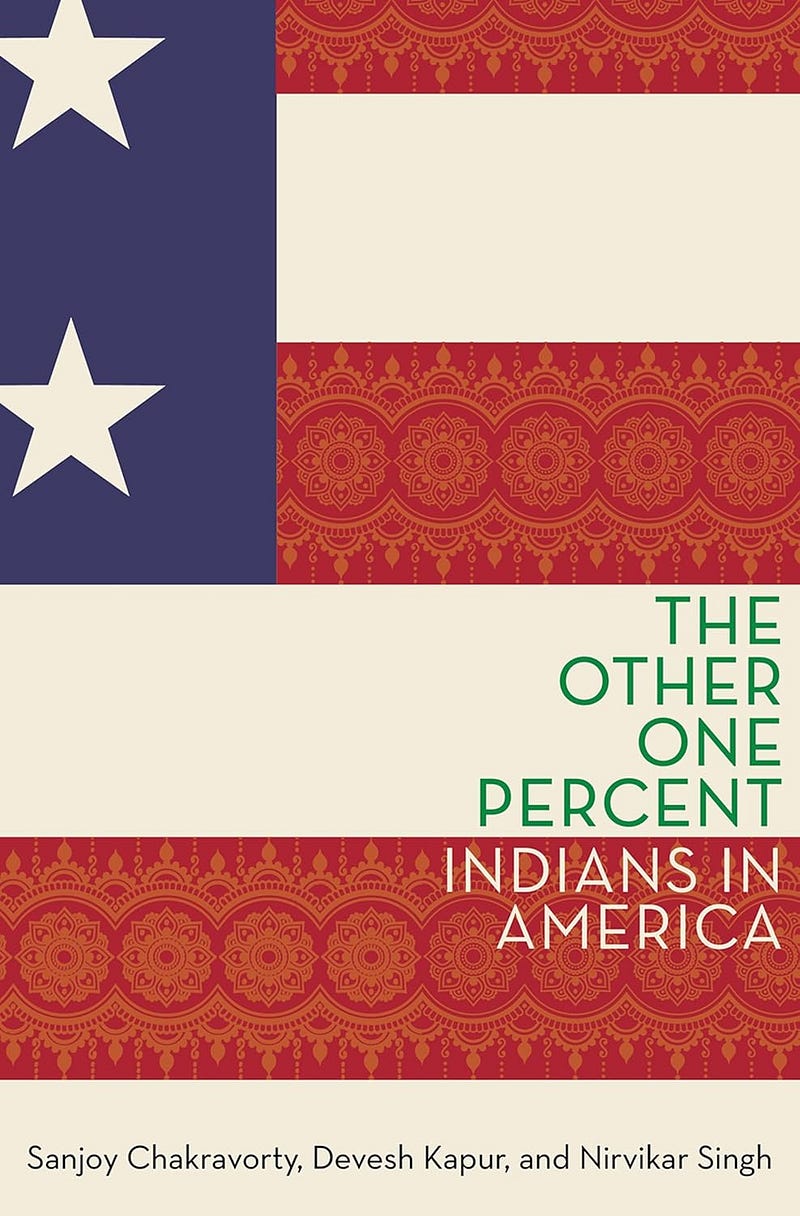
Image Credit: amazon.com
That’s where The Other 1% enters the conversation, offering a refreshingly empirical, sociological investigation into the Indian immigrant journey. The book traces Indian migration to the U.S. back to the early 20th century, mapping every twist and turn: global political shifts, economic crises, legislative reforms, and the push-pull of opportunity and adversity. Every chapter is an antidote to the “model minority myth” — debunking the illusion that all Indian Americans are uniformly successful, wealthy, or powerful.
If you’re tired of hot takes, viral stats, and recycled stereotypes, you’ll appreciate this book’s commitment to data over drama. It constructs its narrative with numbers, contextualizes every rise with a historical reason, and — perhaps at the expense of some heart — lets charts do most of the talking.
For those yearning for more personal stories or gripping prose, this approach may feel clinical.
But there’s no denying the value: on every page, you’ll find context that the headlines inevitably miss.
Bottom line? The Other 1% isn’t here to tell you a rags-to-riches fairytale — nor will it leave you with a simplistic moral about Indian American life. Instead, it’s the book to hand someone who wants to replace myth with measured reality, or who simply wants to understand how a tiny slice of the population became such a lightning rod for both awe and animus. If this is your entry point to the scale and history of Indian immigration in the U.S., you’re starting in exactly the right place.